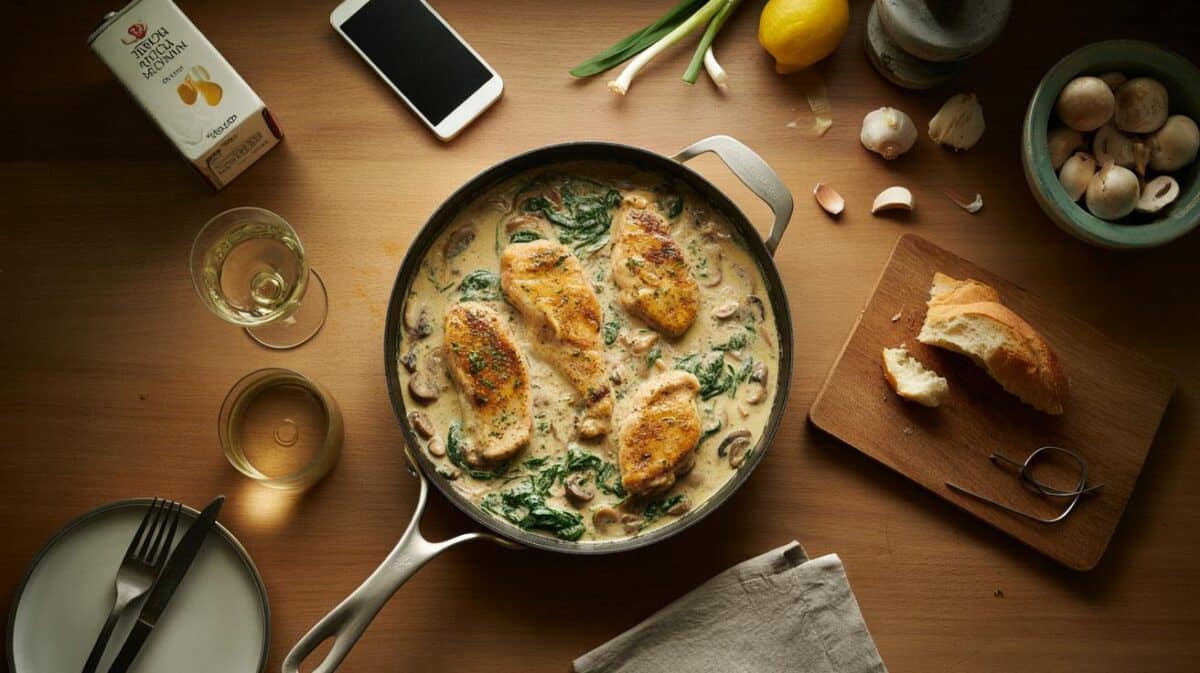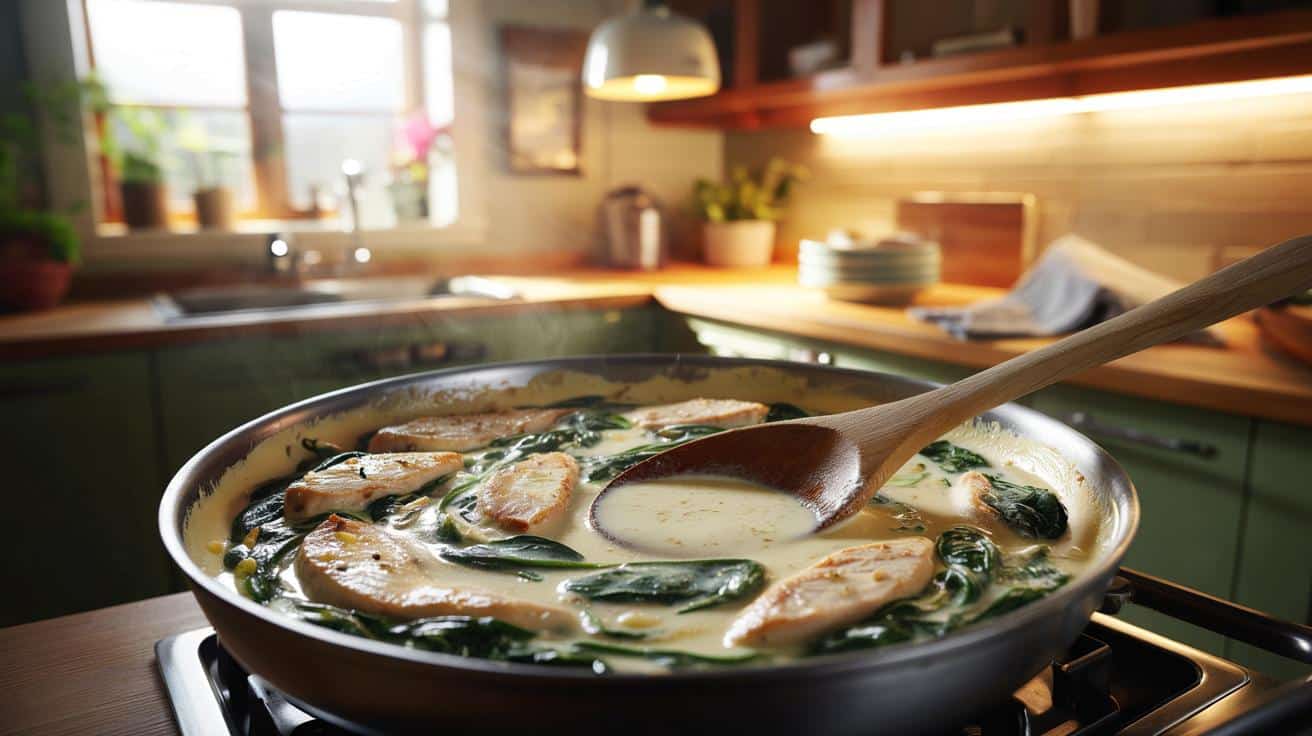
The pan was already hot when I started doubting myself. A weekday evening, brain fried from work, and I was staring at a handful of ingredients that looked… honestly, a bit sad. A carton of cream, a lonely chicken breast, half an onion, a small wedge of Parmesan, and some limp spinach I’d been ignoring for days. This did not look like the kind of dinner that fixes anything.
Still, I chopped, I stirred, I poured. The cream hit the pan with that soft hiss that sounds almost like a sigh. The kitchen steamed up, the smell turned round and rich, and I could suddenly feel my shoulders dropping. I tasted the sauce halfway through, already reaching for the salt.
And then I stopped.
Because for the first time in a long time, I cooked a creamy meal and didn’t feel the need to add anything.
The strange satisfaction of not reaching for the extra “something”
There’s this tiny, almost invisible moment while you cook when doubt kicks in. You lean over the pan, spoon in hand, taste the sauce, and your brain goes: “Okay, what’s missing?” We’re so used to tweaking, fixing, correcting. One more pinch of salt. A squeeze of lemon. A swirl of something fancy you saw on Instagram.
That night, the sauce was already clinging to the spoon like it knew what it was doing. The cream had picked up the garlic, the browned bits from the chicken, the nuttiness from the Parmesan. The spinach had gone silky and dark green. My reflex was still to improve it.
But the flavor was round, deep, complete. And that simple realization felt weirdly… freeing.
We’ve all been there, that moment when dinner feels more like a test than a meal. You open the fridge and play kitchen Tetris with whatever’s left, half expecting disappointment. That evening started exactly like that. I sliced the chicken thin so it would cook fast, softened the onion in a little butter, added a clove of garlic just before it browned.
Then came the cream, cold and heavy, slipping into the pan and lifting all the browned goodness from the bottom. The spinach followed, shrinking immediately, like it was hiding inside the sauce. A handful of grated Parmesan melted straight in, turning everything just slightly elastic. I took a spoonful, fully prepared to sigh and start doctoring it.
Instead, I just stood there at the stove, a bit stunned that this humble, thrown-together dish already tasted complete.
➡️ Most people overlook this everyday posture mistake
➡️ The haircut that makes fine hair look thicker without layers or heavy styling
➡️ People who feel pressure to cope alone often internalize emotional responsibility
➡️ Most people misuse this basic kitchen tool without knowing it
➡️ Workers in this field are in such high demand that salaries keep rising every year
➡️ “This creamy dinner is what I cook when I don’t want leftovers hanging around”
➡️ Psychology explains why emotional processing can feel slow but intense
➡️ “I’m a production systems assistant making $4,550 a month”
There was no secret ingredient. No exotic spice, no twelve-step technique, not even freshly chopped herbs. Just a kind of quiet balance. The salt from the cheese. The sweetness from the onion. The faint bitterness from the spinach. The fat from the cream tying it all together like a soft blanket.
That’s the logic of cream when it’s treated right. It doesn’t shout. It doesn’t need to. It smooths the edges between flavors, carries them instead of competing with them. When the base is simple and well-seasoned from the start, the cream becomes a amplifier, not a cover-up.
*The real magic wasn’t in the recipe, but in stopping before I messed with something that was already working.*
How to build a creamy dish that doesn’t need “saving”
If you want that same “no tweaks needed” feeling, it starts way before the cream hits the pan. The quiet secret is layering flavor from the first minute. A good creamy dish almost always begins with something aromatic in a bit of fat: onion, shallot, garlic, maybe a piece of leek. Let them soften slowly, not scorch.
Then you brown something that can leave a trace. Chicken strips, mushrooms, even chickpeas or sliced zucchini. That caramelized layer on the bottom of the pan is your silent hero. When you pour in the cream, it loosens those browned bits and folds them right into the sauce.
By the time the cream warms through, half the seasoning work is already done. The sauce tastes like it belongs in your kitchen, not in a jar.
The mistake most of us make is using cream like white-out. Something’s bland, so we drown it in dairy and hope for the best. The result is heavy, flat, and weirdly one-note, which is exactly when you start reaching for extra salt, chili flakes, or lemon just to wake it up.
A better way is to season gently at each step instead of all at once at the end. A little salt on the onions. A small pinch on the chicken. A bit more once the cream is in and simmering. Not a flood, just small nudges. Think of it like adjusting the volume on a stereo, not slamming everything to max.
Let’s be honest: nobody really does this every single day. We rush, we eyeball, we pray. But the nights we slow down a bit are the nights the food gives something back.
When that chicken-spinach-cream situation came together, I realized how little I’d actually done. No recipe open on the counter, no measuring spoons, just a rough idea and a little patience. I told a friend about it later and she said something that stuck with me.
“Sometimes the best seasoning is just stopping when it already tastes like home,” she laughed. “We overdress everything, even our food.”
She’s right. We pile extras on our plates and on our lives. So here’s what quietly worked that night:
- Start with one fat (butter or oil), not three competing ones.
- Cook one aromatic gently until sweet, not burnt.
- Let one main ingredient brown properly, without poking it every second.
- Add one creamy element: heavy cream, coconut milk, or crème fraîche.
- Finish with one accent only: cheese, herbs, or a crack of pepper, not all of them.
That small discipline is what made the dish feel finished before the panic adjustments.
When “enough” is actually perfect on the plate
What struck me most that evening wasn’t how good the meal was, but how calm it felt to eat something I hadn’t fussed over. No mental checklist of “next time I’ll add…” running in the background. No low-level annoyance that it was nearly right but not quite there. Just a warm bowl, a quiet kitchen, and a sauce that clung to the fork like it knew what it was here to do.
There was space in that simplicity. Space to taste the cream without guilt. To notice the soft chew of the chicken instead of hunting for the missing spice. To enjoy the spinach for what it was, not as a health badge. That sense of enough is rare in a world where every food video promises “the ultimate version” of everything.
A creamy dish that doesn’t need anything on top is almost a small act of resistance. Against the constant urge to upgrade. Against the idea that basic is boring. Against the reflex to fix what’s already quietly working. It’s just one pan, a few ingredients, and a small, unexpected sense of relief.
Maybe that’s why that simple dinner still lingers in my mind. Not because it was the best thing I’ve ever eaten, but because, for once, my spoon went in, came out, and didn’t immediately reach for something else.
| Key point | Detail | Value for the reader |
|---|---|---|
| Layer flavors early | Start with aromatics and browning before adding cream | Gives depth so the final dish tastes complete without extra fixes |
| Use cream as a carrier, not a cover | Let cream pick up browned bits and balanced seasoning | Achieves rich, rounded flavor instead of heavy blandness |
| Stop before the “over-fix” | Taste, pause, and resist adding five more ingredients | Reduces stress, saves time, and builds confidence in your cooking |
FAQ:
- Question 1How do I stop my creamy sauce from tasting bland?
- Answer 1Season lightly at each stage: aromatics, protein or veg, then the sauce. Use browned bits from the pan and something naturally savory like Parmesan, mushrooms, or soy sauce instead of dumping salt at the end.
- Question 2What type of cream works best for a no-fuss creamy meal?
- Answer 2Heavy cream or double cream is the most forgiving. It reduces well, doesn’t split easily, and gives that full, restaurant-style texture without complicated techniques.
- Question 3Can I get the same effect with non-dairy alternatives?
- Answer 3Yes, full-fat coconut milk or a rich oat cream can work. Just keep the rest of the flavors simple and rely on pan browning and aromatics for depth.
- Question 4How do I know when to stop adding ingredients?
- Answer 4Taste the sauce once it’s slightly thickened and coats the spoon. If it already feels balanced—salty enough, a bit sweet from the onions, no harsh edges—serve it as is and resist the “just one more thing” urge.
- Question 5What can I serve with a rich creamy dish without overcomplicating it?
- Answer 5Plain pasta, rice, crusty bread, or simple steamed vegetables work best. Let the sauce be the star, and keep the sides almost boring on purpose so the whole plate feels harmonious.