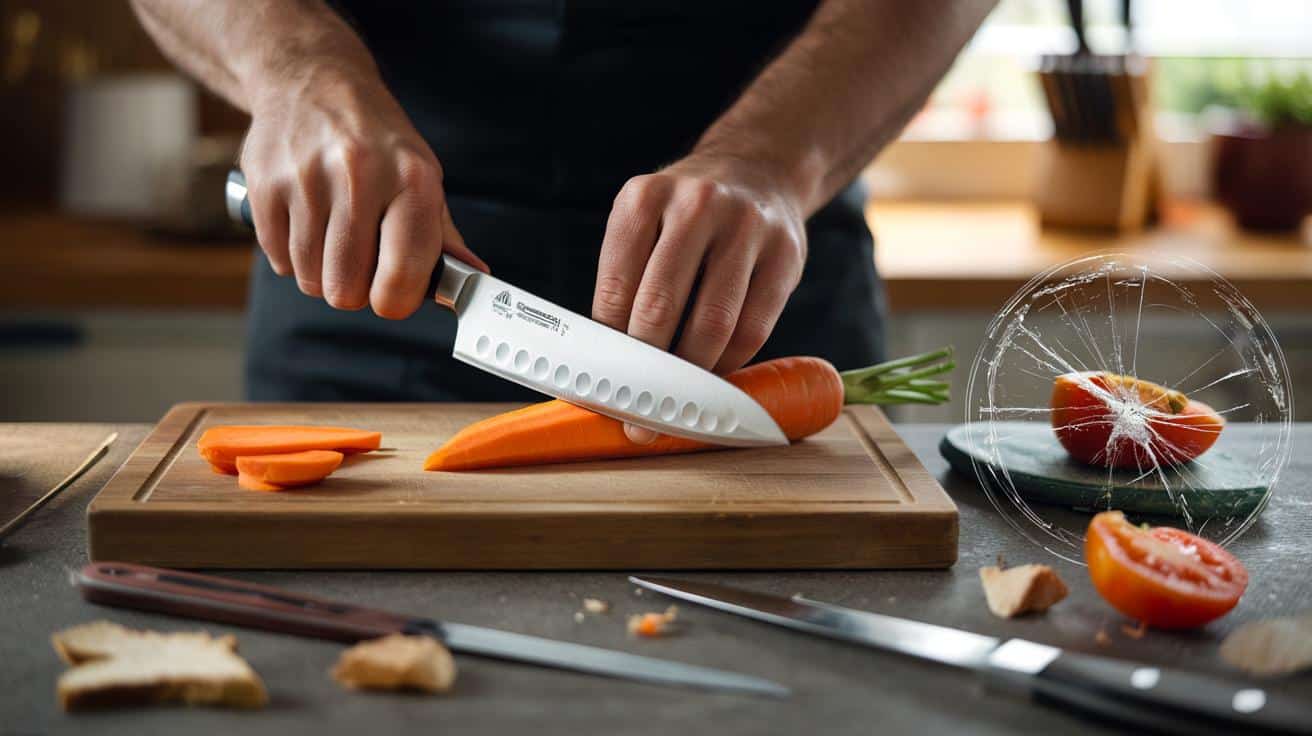
The first time I noticed the problem, I was standing in a friend’s kitchen watching her attack a bunch of carrots. The cutting board slipped a little with every slice, the knife bounced off the surface, and she had that tense, half-scared grip everyone gets when they don’t totally trust the blade in their hands. The knife was big, expensive, and completely dull.
She shrugged and said what so many people say: “I’m just bad at chopping.”
The truth was staring up from the counter: the problem wasn’t her. It was the most basic tool in the room, used every day and misunderstood by almost everyone.
And the risk is way higher than we think.
The basic kitchen tool most of us are using all wrong
Let’s put a name to it: the kitchen knife. That everyday chef’s knife sitting in the block, the one you grab for onions, bread, tomatoes, everything. For most people, it’s both the most used and the least understood tool at home.
You see it in tiny clues. Scratched plates from sawing at food. Crushed tomato skins. Half-cut chicken breasts torn instead of sliced. A knife that feels “safe” because you have to push so hard it slips instead of cuts. This is how small accidents and big frustrations are born, one dull push at a time.
Spend five minutes watching people cook and the patterns jump out. The fingers curled backward, but the wrist locked in a stiff angle. The tip of the knife never leaving the board, or the opposite: the whole blade lifted in the air like a hammer. Most home cooks use a knife like a saw or a cleaver, not a blade designed to glide.
A survey from a UK kitchenware retailer once found that a majority of households hadn’t sharpened their main knife in over a year. Many had never sharpened it at all. They just kept buying new ones when the old ones “went bad.” The misuse is so normalized that people don’t even see it as misuse.
There’s a strange irony here. A sharp knife feels scary, while a dull knife feels harmless. Yet hospitals quietly report something else: more kitchen injuries come from dull blades that slip off onions, apples, and crusty bread. The blade doesn’t bite into the surface, so your hand overcompensates. More force, less control.
The real issue isn’t clumsiness. It’s technique, maintenance, and a myth: that a knife is dangerous mainly because it’s sharp. In reality, **a badly used, badly maintained knife is far more treacherous** in an ordinary home kitchen.
➡️ Psychology explains why emotional processing can feel slow but intense
➡️ Workers in this field are in such high demand that salaries keep rising every year
➡️ I cooked this creamy meal and didn’t feel the need to add anything
➡️ This role offers stable income even without annual raises or promotions
➡️ “This creamy dinner is what I cook when I don’t want leftovers hanging around”
➡️ The haircut that makes fine hair look thicker without layers or heavy styling
➡️ “I’m over 60 and my mornings felt rushed”: the cortisol peak I misunderstood
➡️ “I managed to save $5,000 in 12 months without earning a single extra dollar”
The right way to use a kitchen knife (that nobody taught you)
Picture this: instead of pressing straight down on an onion, your knife moves like a train on smooth tracks. The tip touches the board, the heel of the blade comes down and forward, and the cut happens almost without effort. That’s the basic rocking motion professional cooks learn on day one.
Your guiding hand forms a “claw,” fingertips tucked back, knuckles forward, gently touching the flat side of the blade. The knife doesn’t fly around randomly. It tracks along your knuckles, like a sliding door sticking to its rails. This looks fancy from the outside, but at its core, it’s a slow, repeatable, almost meditative movement.
This is where most people quietly get lost. They grip the handle like a hammer instead of pinching the blade just above the handle with thumb and index finger. That pinch gives control, balance, and makes the knife feel like an extension of your hand, not a foreign object you’re wrestling with.
Then there’s the cutting board. A hard glass or ceramic board will dull your knife fast. A light plastic one that slides across the counter is a wrist sprain waiting to happen. A stable wooden or heavy plastic board with a damp cloth underneath changes everything. Suddenly, your knife has a reliable partner instead of a treacherous dance floor.
Once you feel that stability, the rest follows. You learn that the knife doesn’t need speed, only rhythm. Forward and down, back and up. Tiny movements, the same every time.
- Start slow, even exaggeratedly slow.
- Keep the tip of the knife in light contact with the board when chopping.
- Let the blade do the work; your arm is just the guide.
- Reset your grip whenever you feel tension creep into your wrist.
*This is less about “being good at cooking” and more about learning one simple, repeatable movement you can trust.*
The care ritual nobody sees, but every good cook swears by
Here’s the plain truth sentence people don’t love to hear: **most home knives die young not from use, but from neglect**. They get thrown in the dishwasher, rattled against forks and plates, knocked tip-first into drawers. Then, when they stop cutting, we blame the brand.
Real maintenance is boring, almost invisible. Two or three light strokes on a honing steel before you start cooking. A real sharpening maybe twice a year, either at a shop or with a decent whetstone. Drying the knife by hand instead of letting it rust in the drying rack. None of this is glamorous. All of it makes a massive difference.
There’s also the emotional side: the guilt of admitting your knives are blunt, the feeling that you “should already know this.” Many of us grew up in kitchens where knives were either feared or ignored. No one calmly showed us how to hold one, how to protect the edge, when to retire a hopeless blade.
We’ve all been there, that moment when you’re sawing at a tomato and pretending it’s fine while juice explodes across the cutting board. You’re not lazy or hopeless. You just inherited a culture where a core skill of everyday life got skipped, like a missing chapter in a manual.
“Once you’re used to a truly sharp knife, going back to a dull one feels like driving with the handbrake on,” a Paris-based chef told me. “People think we have secret recipes. Honestly, our biggest secret is that our knives actually cut.”
- Stop putting knives in the dishwasher – High heat, detergent, and banging around destroy the edge and handle.
- Use a honing steel regularly – This doesn’t sharpen, it realigns the edge so it stays effective longer.
- Sharpen, don’t just complain – A cheap, dull knife that’s sharpened well beats an expensive dull one every single time.
- Store smart – A knife block, magnetic strip, or blade guard protects the edge from random impacts.
- Choose one “main” knife you trust – It’s better to master one good chef’s knife than own seven mediocre ones you avoid.
What changes when you finally use this tool the way it was meant to be used
Something subtle shifts when your main kitchen knife suddenly behaves the way it was designed to. You start cooking foods you used to avoid because chopping them was a chore. Onions become a three-minute job, not a messy, tearful battle. You slice through a ripe tomato and the skin doesn’t burst. Meat portions look clean, not ragged.
Beyond speed, there’s a quiet confidence that settles in. You’re less afraid of cutting yourself because the blade goes exactly where your hand intends. You don’t rush. You don’t force it. You stand differently at the counter, a little more grounded, a little less frustrated.
The bigger surprise comes later. You stop blaming yourself for being “bad at cooking” and start noticing the tools and systems around you. Maybe you upgrade your cutting board. Maybe you practice that pinch grip absent-mindedly while waiting for water to boil. Small technical shifts change the emotional weather of the kitchen.
Let’s be honest: nobody really does this every single day. Life happens, knives get neglected, and routines slip. Yet every time you return to that simple ritual—honing, wiping, cutting with intention—you get a glimpse of what cooking can feel like when the basic tools finally cooperate instead of fighting you.
If you’re curious, you don’t need a full makeover. Start with a single test: pick your main knife, get it properly sharpened once, and spend a week noticing the difference in every cut. See how your shoulders feel after chopping. Notice whether you dread prep less. Ask yourself which habits are actually yours, and which are leftovers from a kitchen culture that never taught you the basics.
The knife hasn’t changed in centuries. Our relationship to it can shift in a weekend. And that quiet shift—inside an ordinary kitchen, on an ordinary Tuesday night—might be the most underrated upgrade in your daily life.
| Key point | Detail | Value for the reader |
|---|---|---|
| Correct grip and motion | Pinch the blade, use a rocking motion, guide with knuckles | More control, fewer slips, smoother cuts |
| Basic maintenance | Regular honing, occasional sharpening, gentle cleaning | Longer knife life, safer and easier cooking |
| Right environment | Stable board, proper storage, no dishwashers | Consistent results and less daily frustration |
FAQ:
- Question 1How often should I sharpen my main kitchen knife?For most home cooks, a professional sharpening once or twice a year is enough, as long as you hone lightly before or after cooking sessions.
- Question 2Is a more expensive knife always better?No. A mid-range knife that fits your hand and is sharpened regularly will beat a pricey, dull knife every time.
- Question 3What’s the safest cutting board material?Wood or heavy plastic boards are ideal, as they’re gentle on the blade and don’t slide easily when paired with a damp cloth underneath.
- Question 4Can I learn proper knife technique on my own?Yes. A few short video tutorials and five minutes of slow practice a day are enough to transform your basic chopping skills.
- Question 5What’s the first habit I should change today?Stop using a dull knife. Either sharpen the one you have or pick one good blade and commit to caring for it from now on.